Shenzhen
Shenzhen is just an hour train ride from Hong Kong. I found it a nice shopping place as things are cheaper than in Hong Kong. However, there is not much of sightseeing in Shenzhen. The only place that I visted was the Window of the world, which is a fantastic replica park situated at the Overseas Chinese Town. Here you can see the vivid replicas of the world’s wonders. It's a nice park for photo taking but apart from that, there's nothing much.
Guangzhou
3 hours drive from Shenzhen, you would reach Guangzhou, the capital city of Guangdong Province. I love the Shang Xia Jiu Bu Jie (literally meaning up down 9 steps Shopping Street but it is a long long street) which offers great shopping (better than Shenzhen). If you like, can also took this Zhujiang cruise to view the night scenery. One thing to note is that many hotels do not have heater so during winter season can be pretty cold so do bring pullover to wear to sleep.
Pangyu
Pangyu has this Yuyinshanfang, which is famous for its unique and elegant Garden art.
Zhuhai
Zhuhai is a nice city by the sea. It has famous Mermaid Statue (called the fish girl). One must do in Zhuhai is to eat the seafood! Really cheap and nice!
Macau
Mucau is accessible via a short walk from Zhuhai. Things to see are the famous St.Paul’s Church, Guia Fortress, Chapel of Shengmuxue, i Senado Square, A-Ma Temple, and Macau Tower. For those who want to try their luck, there are so many casinos there, including the nice Venitian (but warn you it is pretty far from the main macau). Do try the Portuguese tart and other Portuguese food and buy the almond biscults.
Showing posts with label China. Show all posts
Showing posts with label China. Show all posts
Friday, November 27, 2009


Thursday, November 26, 2009
Beautiful Zhangjiajie, Fenghuang Ancient Town, Shaoshan & Changsha
I have always wanted to visit the imfamous "Ten Miles Gallery". So, I have decided to spend my last few days of 2008 till the beginning of 2009 in Zhangjiajie, a scenic place in China Hunan province with a friend. This is really one of the most scenic trip that I have been on.... to top it off, it SNOWED!!!
ZhangJiaJie
Flew from Singapore to Xiamen and transit domestic flight to Changsha, a city in the Hunan Province. From Changde, we coached around 4 hours to Zhangjiajie. The day that I arrived in Zhangjiajie was a rainy day and tour guide recommended that we first visit the Longwang Cave (Dragon King Cave), regarded as one of the biggest and oldest caves in China. The cave is pretty interesting. I still recalled that I was freezing outside the cave (it was winter and the temperature drops to only a few degrees celsius plus the wet weather). But once I step into the cave, it was so warm! The cave was lighted with various coloured lights and we are able to see nice rocks formation.

The next morning, the rain has stopped and we tooked a nice boat ride on the tranquil Lake of Baofeng at Suoxiyu Valley (and its waterfall), the highest lake in Hunan. As we are worried the good weather might not last, we decided to ascend Mt Tianzishan while the weather is good. The cable car ride up Tianzishan was like a ride into a fairyland. Mt Tianzishan is noted for its stone forests, cloud seas, twilight and winter snow. We are indeed lucky that it started to snow when we are on top of Mt Tianzishan! The green pine trees with white snow created an extremely beautiful painting. From Tianzishan, we proceeded to Helong Park, Xihai, and Yuanjiajie, famous for the First Bridge under Heaven and Back Garden. Thereafter, we took the fastest and highest lift called the Bailongdianti back down.

The next day, the snowing continued as we toured Huiangshizai, followed by China’s first National Forest Park. Highlight of this tour included the Legendary Golden Whip Stream (Jinbian Stream), with numerous impressive sights along the stretch of 5km stream. Thereafter, we visited the imfamous Ten Mile Scenic Drawing Corridor to explore the picturesque gallery of mountain and river sceneries.

Before we left Zhangjiajie, we made a last stop to Tianmenshan, which can only only be accessed via a 40 minutes cable car ride from the Zhangjiajie city. Tianmenshan, meaning the Heavenly Gate Mountain, is famous for a special "Heavenly Gate", which is a very big whole on one of its peak. The route up to the Heavenly Gate is called the "Road to Heaven", which is a super winding road. It was snowing very heavily when we ascended and the top of the mountain was covered with thick snow. Due to this, we were unable to ride on the "Road to Heaven" änd can only see the Heavenly Gate from afar. But still, it was pretty nice having snow fights, making snowman and playing with the snow at the top of the mountain.

Fenghuang (Phoenix) Ancient Town
After Tianmenshan, we started our long journey to Fenghuang Ancient Town. Enroute (about 3 hours), we stopped at Furong Town. It used to be named Wangcun Village untill a famous movie entitled Furong Town was filmed here. From Furong town, we coached another 5 hours before we reached Fenghuang Ancient Town. It was the night of 31 December 2008. The tiring journey, with winding roads was all worth it. This ancient town is so beautiful! As it was New Year's Eve, a lot of people were gathering at the river to put water lights for good blessing for the coming year. Needless to say, I did that too!
Happy New Year 2009! We started off with a sumptous breakfast of bao and noodles at a road side store (the hotel did not give a good breakfast so the tour guide decided to forgo the hotel breakfast and brought us to the road side store). After which, we proceeded to visit Fenghuang Ancient Town. The ancient town is exquisite
and delicate and has witnessed great changes in history. Inside, there are ancient stone lanes, the unique suspension houses of Tu and Miao tribe and view the Ancient city wall. I would say Fenghuang is really one of the nicest Ancient Town that I have visited.


Shaoshan
From Fenghuang, we took the newly opened expressway to Changde, which took only 5 hours. From there, we coached to Shaoshan where the late leader of China, Mao Ze Dong, was born and grew up. We visited the Mao’s Family home, Mao’s bronze statue and Mao’s Memorial Hall.
Changsha
From Shaoshan, it took another 3 hours to reach Changsha, the capital city of Hunan Province. Changsha is famous for the Yuelushuyuan, an anxient school at the foor of Mt Hengshan, Mawangdui Museum (the tomb where you can see the real corpse of a thousand years old lady) and Hunan embroidery (Xiangxiu). We went to this place called "Fire Palace" for dinner and I would say the food is really nice. Do try out the smelly tofu (it's not smelly at all) and the boba (a sweet glutinous rice ball) and the spicy Hunan cruine. At night, do take a walk at the commercial walking street.
I would say this was the most memorable trip. Zhangjiajia and Fenghuang are indeed places worth visiting!
ZhangJiaJie
Flew from Singapore to Xiamen and transit domestic flight to Changsha, a city in the Hunan Province. From Changde, we coached around 4 hours to Zhangjiajie. The day that I arrived in Zhangjiajie was a rainy day and tour guide recommended that we first visit the Longwang Cave (Dragon King Cave), regarded as one of the biggest and oldest caves in China. The cave is pretty interesting. I still recalled that I was freezing outside the cave (it was winter and the temperature drops to only a few degrees celsius plus the wet weather). But once I step into the cave, it was so warm! The cave was lighted with various coloured lights and we are able to see nice rocks formation.

The next morning, the rain has stopped and we tooked a nice boat ride on the tranquil Lake of Baofeng at Suoxiyu Valley (and its waterfall), the highest lake in Hunan. As we are worried the good weather might not last, we decided to ascend Mt Tianzishan while the weather is good. The cable car ride up Tianzishan was like a ride into a fairyland. Mt Tianzishan is noted for its stone forests, cloud seas, twilight and winter snow. We are indeed lucky that it started to snow when we are on top of Mt Tianzishan! The green pine trees with white snow created an extremely beautiful painting. From Tianzishan, we proceeded to Helong Park, Xihai, and Yuanjiajie, famous for the First Bridge under Heaven and Back Garden. Thereafter, we took the fastest and highest lift called the Bailongdianti back down.

The next day, the snowing continued as we toured Huiangshizai, followed by China’s first National Forest Park. Highlight of this tour included the Legendary Golden Whip Stream (Jinbian Stream), with numerous impressive sights along the stretch of 5km stream. Thereafter, we visited the imfamous Ten Mile Scenic Drawing Corridor to explore the picturesque gallery of mountain and river sceneries.

Before we left Zhangjiajie, we made a last stop to Tianmenshan, which can only only be accessed via a 40 minutes cable car ride from the Zhangjiajie city. Tianmenshan, meaning the Heavenly Gate Mountain, is famous for a special "Heavenly Gate", which is a very big whole on one of its peak. The route up to the Heavenly Gate is called the "Road to Heaven", which is a super winding road. It was snowing very heavily when we ascended and the top of the mountain was covered with thick snow. Due to this, we were unable to ride on the "Road to Heaven" änd can only see the Heavenly Gate from afar. But still, it was pretty nice having snow fights, making snowman and playing with the snow at the top of the mountain.

Fenghuang (Phoenix) Ancient Town
After Tianmenshan, we started our long journey to Fenghuang Ancient Town. Enroute (about 3 hours), we stopped at Furong Town. It used to be named Wangcun Village untill a famous movie entitled Furong Town was filmed here. From Furong town, we coached another 5 hours before we reached Fenghuang Ancient Town. It was the night of 31 December 2008. The tiring journey, with winding roads was all worth it. This ancient town is so beautiful! As it was New Year's Eve, a lot of people were gathering at the river to put water lights for good blessing for the coming year. Needless to say, I did that too!
Happy New Year 2009! We started off with a sumptous breakfast of bao and noodles at a road side store (the hotel did not give a good breakfast so the tour guide decided to forgo the hotel breakfast and brought us to the road side store). After which, we proceeded to visit Fenghuang Ancient Town. The ancient town is exquisite
and delicate and has witnessed great changes in history. Inside, there are ancient stone lanes, the unique suspension houses of Tu and Miao tribe and view the Ancient city wall. I would say Fenghuang is really one of the nicest Ancient Town that I have visited.


Shaoshan
From Fenghuang, we took the newly opened expressway to Changde, which took only 5 hours. From there, we coached to Shaoshan where the late leader of China, Mao Ze Dong, was born and grew up. We visited the Mao’s Family home, Mao’s bronze statue and Mao’s Memorial Hall.
Changsha
From Shaoshan, it took another 3 hours to reach Changsha, the capital city of Hunan Province. Changsha is famous for the Yuelushuyuan, an anxient school at the foor of Mt Hengshan, Mawangdui Museum (the tomb where you can see the real corpse of a thousand years old lady) and Hunan embroidery (Xiangxiu). We went to this place called "Fire Palace" for dinner and I would say the food is really nice. Do try out the smelly tofu (it's not smelly at all) and the boba (a sweet glutinous rice ball) and the spicy Hunan cruine. At night, do take a walk at the commercial walking street.
I would say this was the most memorable trip. Zhangjiajia and Fenghuang are indeed places worth visiting!
Thursday, October 29, 2009
Shanxi: In Search of Duke of Mt Deer
Since watching the Duke of Mount Deer, I always wish that one day I could visit the infamous Wutaishan where it was rumoured that the Qing Dynasty Emperor Shun Zi (Emperor Kang Xi’s father) went to become a monk. So, mid of April this year, I decided to fulfil my long time wish and planned my own trip to Shanxi province in China (where Wutaishan is situated).
There is no direct flight to Shanxi so I have to fly to Beijing and took a domestic flight to Datong, a city in Shanxi. As the domestic flight is early the next morning, I took the opportunity to walk around Beijing, a place where I have not visited for the last 10 years. I revisited the Temple of Heaven, the venue for worshipping the heaven and pray for good harvest in the Ming and Qing dynasty. Other places that I went included a pleasant walk along Wangfujing Street, Tiananmen Square, Main Stadium and Olympic Village for Beijing Olympic 2008, the Hutongs and local old Siheyuan Houses.
Datong
Very early the next morning (I have to woke up at 4 am!!!), I went to the airport to catch my early 7 am flight to Datong, the northern city in Shanxi. It is one of the 24 historical and cultural cities in China, neighboring Hebei Province to the east and Inner Mongolian to the north. This place used to be considered as the barbarian place and part of Mongolia as it was located outside the Great Wall beyond the Yanmen Pass.
 The Yungang Grottoes (Cloud Ridge Caves) in the outskirts of Datong is a treasure trove of Buddhist carvings unrivaled in the world with a variety of more than 51,000 statues. Yungang Grottoes, together with Longmen Grottoes in Luoyang, Dunhuang Grottoes and Maijishan Grottoes in Gansu, are considered as the Four Greatest Buddha Grottoes in China.
I also visited the original Jiulongbi (Nine-dragon sacreen) built in Ming Dynasty in front of the mansion of Ming Emperor Taizu. The Qing royalties loved it so much that a relica of the masterpiece was erected in the Imperial Palace and Beihai in Beijing. Other famous structural buildings of the Liao Dynasty include the Huayen Temple and Shan Hua Temple.
 The next day, on my way to Wutaishan, I dropped by Xuankong Si (Hanging Monastery) at Mt.Hengshan. Built precariously on sheer cliffs above Jinlong Canyon, the monastery dates back more than 1400 years. Its halls and pavilions were built along the contours of the cliff face using the natural hollows and outcrops. It is really a great architecture work and I wonder how the workers managed to build such a temple hanging on Mt Hengshan in ancient times where technology is not that advance. Before reaching Wutaishan, I made one last stop at Yingxian Wooden Pagoda, the biggest wooden pagoda in China. It was built by Empress Xiao of the Liao Dynasty (the Liao Empress in the show “The Yang Warriors”).
Wutaishan
 The scenic ride to Wutaishan (Five-terrace Mountain) from Yingxian took around 3 hours. When I almost reach Wutaishan, the driver suddenly asked me to see the snow. I initially thought he was joking, but no, it was really snowing!!! The other name of Wutaishan is called Qing Liang Shan meaning Cool Mountain, where the temperature at the mid of summer is no more than 20 degree Celsius. The mountain is said to be the most beautiful during winter season as it would be covered wholly in white snow. But few people have the guts to visit it in winter due to the extremely cold temperature and also the roads up and down the mountain would be block by snow. Hence, I was overjoyed at the sight of snow falling. I have expected the mountain to be cooling at this time, but I have not expected to see snow as this is coming to the end of spring!
 Centered on the beautiful monastic village of Taihuai, it is one of China’s four sacred Buddhist Mountains. It lies deep in an alpine valley enclosed by the five peaks. I visited a number of temples in Mt Wutai, including Xiantong Temple, Tayuan Temple, and Fo Mu Cave. However, the most scenic view was at the peak of southern terrace, as well as the Dailuo Peak. At the top of these 2 places, I really feel like I am at the top of the world (but there’s a price to pay, which is the freezing sensation!)
Taiyuan
After spending a couple of days climbing up and down in Wutaishan, I left the place and went to other parts of Shanxi. I visited the Jinci Temple in Taiyuan, the capital of Shanxi province. Jinci Temple is a combination of historical cultural relics (the place where the Zhou Dynasty Emperor commemorate his mother) and beautiful landscapes and is known as a little Jiangnan in Shanxi.
Hongdong
 About 2 hour drive from Taiyuan is the Qiao Family Compound. Built in 1755 (Qing Dynasty), this well-preserved and exquisite structure used to be the residence of Qiao Zhiyong, who was a famous businessman during the Qing dynasty. Now it is reputed as a bright pearl of North China’s residential architecture. It was used to film the popular movie “Dahong Denglong Gao Gao Kua” (Hang the Red Lanterns High).
In Hongdong, I visited the Big Chinese Sholar tree (the place where it was believed that our ancestors came from) and Susan Prison, a Ming Dynasty (1368 – 1644 AD) construction and the earliest surviving prison still in China.
Yuncheng
Yuncheng, located at the most southern part of Shanxi, was the place where Guangong (the famous red face character in the romance of the 3 kingdoms) was born. I have visited the Guangong Temple in Luoyang, where Guangong’s head was buried. That’s why when the driver suddenly asked me if I was interested to make a trip to Yuncheng, I immediately said yes. I would say the long 4 plus hours of journey from Linfen is worth it as the temple, being in his hometown, is the most respected Guangong Temple in China.
Linfen
After the visit, I went back to Linfen and visted the Yao Temple, an important cultural relic with more than 1400 years history. It has been the place for people to offer sacrifice to Emperor Yao in different dynasties.
 The journey to the Hukou Waterfall from Linfen is a tiring journey along winding mountain roads and bumpy roads. I almost felt as if I am back in India when I travelled on this kind of road!!! But when I see the Hukou Waterfall, all my grievances about the journey were gone. The sight was spectacular. I understand from a local guide that when the Yellow River runs all the way from Qinghai Province to the border of Shanxi and Shaanxi provinces, zigzagging to Jixian in Shanxi Province and Yichuan in Shaanxi Province, it suddenly finds it way through a narrow valley guarded by flocks of flourishing forests on both sides. The riverbed of the Yellow River narrows from 300m to 50m, turning the tranquil river into a turbulent one. It is this narrow path that makes Hukou Waterfall popularity unequalled in China. The tremendous water splashes on the rocks, causing countless waterbeads and foam, then water funs from which visitors may notice a colourful rainbow by chance. The water fumes curl upwards, turning from yellow to grey, grey to blue, which people call “smoke from the river”. I went down to the bottom of the waterfall also which is called Long Gong (or the dragon palace) and got myself all wet from the Yellow River water rushing down the waterfall!!! It was really a fun experience :=P
Pingyao
 My last stop at Shanxi was at Pingyao Ancient City. It was built in 1370 AD during the Ming dynasty. Though it had been repaired in Ming and Qing dynasty, it has kept the original look of the early Ming dynasty. I visited the Rishengchang Financial House Museum, the Ancient Qing and Ming Street, and the Gu Xian Ya (Yamen in Old China). But one caution for travellers to Pingyao: the local guide is not very honest and conned us into entering a building where we are forced to see our fortune. And the worst part is that they refuse to let people leave if you don’t pay up for their “service”. So beware!
Another thing about Shanxi is that the hotels might not have currency exchange counter and it is rather difficult to change Chinese Yuan in this province. So, if you intend to buy things, remember to bring more Yuan there, as a lot of places don’t accept VISA or Mastercard.
I transferred from Taiyuan back to Beijing to catch my flight back to Singapore. While waiting for my flight in Beijing (which is at midnight), I spent my time visiting the Ming Tombs and the Summer Palace, also known as Yiheyuan, and enjoyed the Beijing roast duck at Chuan Ju De, the famous roast duck store in Beijing. Apart from the incident in Pingyao, I would say that my whole Shanxi/Beijing trip is really fun and enjoyable. I got a taste of what a Ke Zhang (a shop in ancient days that people slept overnight) living is and experience sleeping on a Kang in the Ke Zhang in Pingyao. Anyone interested to go there again? I can pass to you my itinerary.
There is no direct flight to Shanxi so I have to fly to Beijing and took a domestic flight to Datong, a city in Shanxi. As the domestic flight is early the next morning, I took the opportunity to walk around Beijing, a place where I have not visited for the last 10 years. I revisited the Temple of Heaven, the venue for worshipping the heaven and pray for good harvest in the Ming and Qing dynasty. Other places that I went included a pleasant walk along Wangfujing Street, Tiananmen Square, Main Stadium and Olympic Village for Beijing Olympic 2008, the Hutongs and local old Siheyuan Houses.
Datong
Very early the next morning (I have to woke up at 4 am!!!), I went to the airport to catch my early 7 am flight to Datong, the northern city in Shanxi. It is one of the 24 historical and cultural cities in China, neighboring Hebei Province to the east and Inner Mongolian to the north. This place used to be considered as the barbarian place and part of Mongolia as it was located outside the Great Wall beyond the Yanmen Pass.
 The Yungang Grottoes (Cloud Ridge Caves) in the outskirts of Datong is a treasure trove of Buddhist carvings unrivaled in the world with a variety of more than 51,000 statues. Yungang Grottoes, together with Longmen Grottoes in Luoyang, Dunhuang Grottoes and Maijishan Grottoes in Gansu, are considered as the Four Greatest Buddha Grottoes in China.
I also visited the original Jiulongbi (Nine-dragon sacreen) built in Ming Dynasty in front of the mansion of Ming Emperor Taizu. The Qing royalties loved it so much that a relica of the masterpiece was erected in the Imperial Palace and Beihai in Beijing. Other famous structural buildings of the Liao Dynasty include the Huayen Temple and Shan Hua Temple.
 The next day, on my way to Wutaishan, I dropped by Xuankong Si (Hanging Monastery) at Mt.Hengshan. Built precariously on sheer cliffs above Jinlong Canyon, the monastery dates back more than 1400 years. Its halls and pavilions were built along the contours of the cliff face using the natural hollows and outcrops. It is really a great architecture work and I wonder how the workers managed to build such a temple hanging on Mt Hengshan in ancient times where technology is not that advance. Before reaching Wutaishan, I made one last stop at Yingxian Wooden Pagoda, the biggest wooden pagoda in China. It was built by Empress Xiao of the Liao Dynasty (the Liao Empress in the show “The Yang Warriors”).
Wutaishan
 The scenic ride to Wutaishan (Five-terrace Mountain) from Yingxian took around 3 hours. When I almost reach Wutaishan, the driver suddenly asked me to see the snow. I initially thought he was joking, but no, it was really snowing!!! The other name of Wutaishan is called Qing Liang Shan meaning Cool Mountain, where the temperature at the mid of summer is no more than 20 degree Celsius. The mountain is said to be the most beautiful during winter season as it would be covered wholly in white snow. But few people have the guts to visit it in winter due to the extremely cold temperature and also the roads up and down the mountain would be block by snow. Hence, I was overjoyed at the sight of snow falling. I have expected the mountain to be cooling at this time, but I have not expected to see snow as this is coming to the end of spring!
 Centered on the beautiful monastic village of Taihuai, it is one of China’s four sacred Buddhist Mountains. It lies deep in an alpine valley enclosed by the five peaks. I visited a number of temples in Mt Wutai, including Xiantong Temple, Tayuan Temple, and Fo Mu Cave. However, the most scenic view was at the peak of southern terrace, as well as the Dailuo Peak. At the top of these 2 places, I really feel like I am at the top of the world (but there’s a price to pay, which is the freezing sensation!)
Taiyuan
After spending a couple of days climbing up and down in Wutaishan, I left the place and went to other parts of Shanxi. I visited the Jinci Temple in Taiyuan, the capital of Shanxi province. Jinci Temple is a combination of historical cultural relics (the place where the Zhou Dynasty Emperor commemorate his mother) and beautiful landscapes and is known as a little Jiangnan in Shanxi.
Hongdong
 About 2 hour drive from Taiyuan is the Qiao Family Compound. Built in 1755 (Qing Dynasty), this well-preserved and exquisite structure used to be the residence of Qiao Zhiyong, who was a famous businessman during the Qing dynasty. Now it is reputed as a bright pearl of North China’s residential architecture. It was used to film the popular movie “Dahong Denglong Gao Gao Kua” (Hang the Red Lanterns High).
In Hongdong, I visited the Big Chinese Sholar tree (the place where it was believed that our ancestors came from) and Susan Prison, a Ming Dynasty (1368 – 1644 AD) construction and the earliest surviving prison still in China.
Yuncheng
Yuncheng, located at the most southern part of Shanxi, was the place where Guangong (the famous red face character in the romance of the 3 kingdoms) was born. I have visited the Guangong Temple in Luoyang, where Guangong’s head was buried. That’s why when the driver suddenly asked me if I was interested to make a trip to Yuncheng, I immediately said yes. I would say the long 4 plus hours of journey from Linfen is worth it as the temple, being in his hometown, is the most respected Guangong Temple in China.
Linfen
After the visit, I went back to Linfen and visted the Yao Temple, an important cultural relic with more than 1400 years history. It has been the place for people to offer sacrifice to Emperor Yao in different dynasties.
 The journey to the Hukou Waterfall from Linfen is a tiring journey along winding mountain roads and bumpy roads. I almost felt as if I am back in India when I travelled on this kind of road!!! But when I see the Hukou Waterfall, all my grievances about the journey were gone. The sight was spectacular. I understand from a local guide that when the Yellow River runs all the way from Qinghai Province to the border of Shanxi and Shaanxi provinces, zigzagging to Jixian in Shanxi Province and Yichuan in Shaanxi Province, it suddenly finds it way through a narrow valley guarded by flocks of flourishing forests on both sides. The riverbed of the Yellow River narrows from 300m to 50m, turning the tranquil river into a turbulent one. It is this narrow path that makes Hukou Waterfall popularity unequalled in China. The tremendous water splashes on the rocks, causing countless waterbeads and foam, then water funs from which visitors may notice a colourful rainbow by chance. The water fumes curl upwards, turning from yellow to grey, grey to blue, which people call “smoke from the river”. I went down to the bottom of the waterfall also which is called Long Gong (or the dragon palace) and got myself all wet from the Yellow River water rushing down the waterfall!!! It was really a fun experience :=P
Pingyao
 My last stop at Shanxi was at Pingyao Ancient City. It was built in 1370 AD during the Ming dynasty. Though it had been repaired in Ming and Qing dynasty, it has kept the original look of the early Ming dynasty. I visited the Rishengchang Financial House Museum, the Ancient Qing and Ming Street, and the Gu Xian Ya (Yamen in Old China). But one caution for travellers to Pingyao: the local guide is not very honest and conned us into entering a building where we are forced to see our fortune. And the worst part is that they refuse to let people leave if you don’t pay up for their “service”. So beware!
Another thing about Shanxi is that the hotels might not have currency exchange counter and it is rather difficult to change Chinese Yuan in this province. So, if you intend to buy things, remember to bring more Yuan there, as a lot of places don’t accept VISA or Mastercard.
I transferred from Taiyuan back to Beijing to catch my flight back to Singapore. While waiting for my flight in Beijing (which is at midnight), I spent my time visiting the Ming Tombs and the Summer Palace, also known as Yiheyuan, and enjoyed the Beijing roast duck at Chuan Ju De, the famous roast duck store in Beijing. Apart from the incident in Pingyao, I would say that my whole Shanxi/Beijing trip is really fun and enjoyable. I got a taste of what a Ke Zhang (a shop in ancient days that people slept overnight) living is and experience sleeping on a Kang in the Ke Zhang in Pingyao. Anyone interested to go there again? I can pass to you my itinerary.
Shandong, Henan & Shanghai
Time flies, and a year passed by from my last trip to China. This year, I decided to return to China (yet again). I have chosen Shandong & Henan for this year trip and would transit in Shanghai and stayed 3 days there.
On 12 April 2006, I took a night flight to Shanghai and was over-joyed by the upgrade to business class by SIA. As the seat was very spacious, I had quite a good rest on the flight and arrived in Shanghai fresh at 6 am on 13 April. After arrival in Shanghai, I took an internal flight to Qingdao, the most eastern city in Shandong, famous for its "green sea and blue sky".
Qingdao
 Qingdao left me with wonderful memories, with its beautiful cherry blossoms and seaview, and its sumptous seafood delights. The weather here is also extremely cooling, with temperature averaging around 13 degrees C.
Upon arrival at Qingdao around 2 pm, we went to Mt Laoshan, located at the east of Qingdao, one of China's famous Taoism centers known as "The Home of Fairies". Here, I visisted the Taiqinggong Temple, where the Quanzhen sect resides. After reading so much on the Quanzhen sect from the martial arts novel written by Louise Chiu, I finally get to see what the real Quanzhen sect really is.
The next day, I indulged in the colourful cherry blossom and tullips at Zhongshan Park – a spectacular sight of a lifetime. The sakura is said to be "imported" from Japan during Japanese occupation many years ago. The sight of the "sakura walkway" really makes me feel like I am in Japan!
Afterwhich, I visted the huashilou (flower stone villa), one of the villa at Badaguan (translated into English as the Eight-passes because it is where 8 foreign embassies used to be located), a villa district with impressive architecture and the German Governor Residence. I also visted the Xiaoyushan (Little-Fish Hill) and the Little Qingdao (an island off Qingdao which offers 360 degrees view of Qingdao) and also enjoy refreshing beer at Qingdao beer brewery.
Weifang
On my way from Qingdao to Jinan, I made a short stop at a little town called Weifang. This town is well-known as the hometown of kites. Here, I learnt more about the art of kite flying at Yangjiafu Folklore Grand View Garden and how kites were made.
Linzi
 After around 2 hours journey from Weifang, I stopped again at Linzi (also known as Zi Bou), a small city in Shandong. Linzi is the capital of the ancient Qi, a country during the sping-autumn dynasty in China. Here is most worthwhile stop in my whole trip and I learnt a great deal of the history of Qi in the Qi historical museum. I also visted a burial site of the King of Qi, which is similar to the Terra Cotta Warrior and Horse Figurine in Xian, except that the horses buried here are REAL horses. I can still see the remains of the horses (see picture).
Jinan
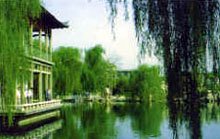
After 2 hours ride, I arrived at Jinan, the capital of Shandong Province, well-known for its Daming (Gleaming Brightness) Lake, a natural Lake originating from the Spring of Pearl, Spring of Furong and Pool of Wangfu located in the city area. I enjoyed a scenic cruise on the lake and stopped at an island in the middle of the lake, where the Qing emperor, Qianlong, is said to reside there for sometime (where the novel "Huan Zhu Ge Ge" started).
I was also fascinated by the spectacular Baotu (Leaping) Spring and Heihu (Black Tiger) Spring in Jinan, which had been commended by Emperor Qianlong as the the number one spring in China. Many Chinese were gathering at the springs to collect water for their consumption (said to be good for one's health and able to cure diseases), which my tour guide said was a common sight. But he warned us from consuming the spring water as we might not be used to the minerals in there.
Taian
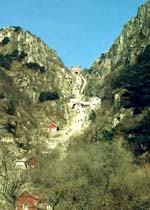 My trip also entails the climbling of Mt. Taishan, which ranks first among China’s five sacred mountains. Legend has it that this mountain is the head of Pangu, an ancient god which created heaven and earth and this is the place where ancient emperors made prayers to heaven in the hope of a prosperous year ahead. At the summit of Daiding, one can enjoy the four magnificent sights: the sunrise, sunset, the golden river and the sea of cloud. As it was Sunday, the peak was filled with many people, mostly the Chinese. The climb was tiring, especially the coming down part as the wind is very strong and keeps pushing me sideways. I saw the Nantianmen and climbed all the way to the peak of Taishan (at 1545m), where Yuwangdian (the emperor of heaven) is located.
Qufu
Departing Taian, i moved on the Qufu, the hometown of Confucius. The Confucian temple, one of the 3 maginifant structures in China (which includes the Taihe Dian in the Forbidden City, the the Dai Temple) is dedicated to worship the great Teacher, Confucius. The Confucian Mansion is the place where the descendants of Confucius used to live. And the Confucian Woods is the burial place of Confucius and his descendants. Here, I get to appreciate confucianism, the teachings of Confucius, which is aimed to cultivate oneself so that one can managed one's household and serve one's country.
Peony in Heze & Luoyang
 My last stop in Shandong is Heze, home of peony, known previously as Caozhou in the olden days. Here, I marveled the beautiful peony in a vast peony nursery. An ancient Chinese saying goes like this: The best peony is in Louyang and Louyang’s best peony is in Caozhou. Heze has a long history of cultivating the more than 600 varieties of peony.
However, it might be due to the temperature, but the peony at Luoyang in Henan province seems to blossoms more beautifully.
Kaifeng
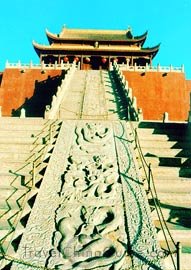
Departing the Shandong province, I moved to Kaifeng, a city in Henan province, which had been served as the capital for seven dynasties. Believe most people would know Kaifeng, where the impartial judge with a black face, Bao Gong, resides. I visted the Longting (Dragon) Pavilion, which was built in the Qing Dynasty, and the infamous Tieta (Iron) Pagoda bearing fine sculpture on its wall.
Found to the northwest of the city, the Dragon Pavilion is a palatial hall built on a thirteen-meter-high marble terrace. During the Song and Jin dynasties, this was the site of imperial palaces. In the Ming period, an official's residence complete with garden was constructed. A pavilion was added during the reign of Guangxu (1672). Inside the pavilion are enshrined the emperor's tablets. Two dragons playing with a pearl are carved on a plaque on the pavilion, hence the name, Dragon Pavilion. It became an important place for local and official ceremonies and festivities. Another hall was added during the reign of Qing Yongzheng. From the hall, a five minute walk will bring you to Wuchao Gate, the site of the imperial palace of the Song Dynasty. The road leading to Wuchao Gate, is surrounded by a blue clear lake. The western lake is called "Lake of Family Yang" and the eastern called "Lake of Family Pan". Both families are renowned in the Song period. It was rumoured that the western lake (the Yang lake) was clear whereas the eastern lake (the Pan late) was cloudy in the past, indicating the Yang's loyalty and honesty and the Pan's treachery.
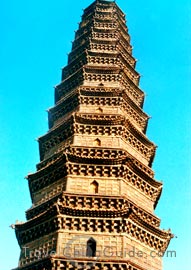 The Iron Pagoda was set up in 1049 AD, Northern Song Dynasty (960-1127), given another name " Pagoda of Youguo Temple" and was built to consecrate the Buddhist Remains of the Sakyamuni, the founder of Buddhism (the former prince in India). The Iron Pagoda experienced many disasters such as wars, floods, and earthquakes in the past. Although the foundation has been ruined, the main body of Iron Pagoda still stands in Kaifeng and ranks the most famous pagoda in China. And 1, 000 years has passed, everything presents a new face including Kaifeng (it is no longer the capital city of Song Dynasty). But, the Iron Pagoda is still the top pagoda in China. So, this is the only structure in Kaifeng that exist since Song Dynasty! The tieta (Iron Pagoda), which resembles the Tower of Pisa with its slanting look, is not really made of iron. In fact, it was once a wooden pagoda, designed by Yuhao, a most famous architect in Song Dynasty, but the original pagoda was ruined by lightning. The pagoda was subsequently rebuilt and brown tiles are used which makes the pagoda looks like iron under sunlight thus gotten the name "Tieta".
Dengfeng
 The TV show, Shaolin Temple, flimed many years ago brought fame to this temple located in one of the 5 scared hills of China known as the middle hill, Songshan. Here, I visited the temple and the padagos of the deceased monks (where most martial arts show of Shaolin is filmed). The trip to Shaolin Temple is completed with a display of Shaolin Wushu, which almost made me breathless with the monks capability to break metal plates with their heads, suck a bowl with their stomache (and none of us is able to pull it off), and so on.
Luoyang

After visiting Shaolin Temple, I travelled for 3 hours to reach Luoyang, another ancient city along the Yellow River. Here, I visted the Longmen Grottes, the white horse temple, the Luoyang peony and Guan Forest.

Longmen Grottoes in Luoyang , Yungang Grottoes in Shanxi Datong and Mogaoku Grottoes in Gansu Dunhuang are called three grottoes artistic treasure-house in China and famous in the world. Longmen Grottoes was started to build from the year of Xiaowendi Taihe 18(494 A.D.), lasted about 400years and passed many dynasties. Its building time is the longest and the project is the largest among all cultural relics. There are 100,000 images of Buddha and 3600 pieces of inscription kept undamaged among 2000 caves,about 40 Buddiha Towers. Longmen Grottoes was distributed mainly in the cliff of Longmen hill and Xiang hill in two sides of Yi river, Luoyang suburbs, it is about 1000 metres long. Fengxian temple, with the 17.14meter high grand buddha, is the largest and typical open stone inscription art.
The white horse temple is the "Grandfather of the Temples" as it is the first buddhist temple in China. It is said that King Yongping of Eastern Han Dynasty (25 ~ 220A.D.) sent monks Cai Yin and Cai Jing to India to ask for scriptures of Buddhism. Three years later, they got the scriptures. During the return trip, they met monks She Moteng and Zhu Falan near the north of Afghanistan. The year after they returned, a temple was built to keep those scriptures. As the two monks used a white horse helped them transport the scriptures back to Luoyang, the temple is thus named White Horse Temple. There are a pair of white horses and a pair of lions at the gate of the temple. They symbolize "if you are going to study the deep knowledge of Buddhism, you should have a great deal of perseverance and willpower, and you shouldn't be afraid of difficulties". They have been standing at the gate and accompanying the temple for more than a thousand years.
Located 7 km south of Luoyang is the Lord Guan (alias Guan Yu)'s Forest. The forest consists of hundreds of ancient pine and plum trees; this is a famous view of Luoyang. Guan Yu is one of the heros in the Three Kingdoms period, having brotherhood ties with Liu Bei (the king of Shu) and Zhang Fei. The temple of Guan Yu was originally built in Tang Dynasty. The temple we see today was built in Ming and Ch'ing Dynasty. Behind the Lord Guan's Forest, there is the tomb of Guan Yu. Legend said that people buried his head (which was cut down by the king of Wu, Sun Quan in his attempt to push the blame to Cao Cao, the king of Kui) in the tomb. The tomb is 20 meters high, with characters saying "the Tomb of Guan Yun Chang, the Shou Ting Hou of Han Dynasty" carved on the tomb inscription.
Zhengzhou
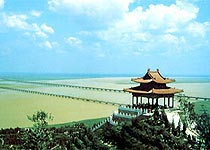 There's a Chinese saying, "One's heart would not die unless one reaches the Yellow River." The Yellow River is seen as the mother river of Han-Chinese as it was historically recorded that early civilisation of Han-Chinese originated around the Yellow River. Here, I enjoyed a Yellow River cruise on board of a hovercraft, which includes a stop at a partially dried river bed in the middle of the Yellow River.
Shanghai
After visiting Shandong and Henan provinces, I returned to Shanghai and stayed 3 days there. I visted my auntie and her family there and have fun with my 2 little cousins. There, I also visted the Longhua temple, the oldest temple in Shanghai, which I missed out in my previous 2 trips there. The most memorable part in Shanghai is my cousin's birthday celebration, and he was so touch that we flew all the way there to celebrate his birthday :)
Anyway, this trip to Shandong/Henan/Shanghai left me with wonderful memories and I wish for the chance to be able to visit these places again sometime.
Scenic Jiangnan
The trip is the first time I took an overnight flight.... so tiring. A round of applause to the exceptionally excellent service by the SIA stewardess. Always wake me up to eat, eat and EAT, (but all i want is to sleep, SLEEP and SLEEP!!!).
Oh, have u watch sunrise before? Managed to catch a glimpse of sunrise on top of the plane. Real nice.
Oh, have u watch sunrise before? Managed to catch a glimpse of sunrise on top of the plane. Real nice.
Suzhou

Okie, my first stop after landing in Shanghai is at Suzhou which is famous for its landscaped gardens. It took around 3 hrs bus ride to travel there. Visited a famous garden (liu yuan), which is listed in the World Cultural Heritage, the Hanshan Temple, which is one of the ten most famous temples in China. During Chinese New Year’s Eve, thousands of visitors at home and abroad gather inside and outside of the temple to listen to the one hundred and eight bell tolls at the same time praying for luck and happiness in the New Year. I paid 5 yuan to go up the bell tower to knock 3 times on the bell. Hopefully, that would bring me good luck :)
Also visted the silk factory and witness how silk is produced. Of course, I bought the imfamous silk blanket....
Hangzhou

After Suzhou, we went to Hangzhou, famous for the West Lake. I took a cruise on the West Lake, visted the Meijiawu Tea Garden (where the TV show on the tea drama was shot), and visted the Yue Fei's temple which was built in 1221 to honour General Yue Fei who made such a great contribution to China defending his country against the aggression of Jin invaders. Also went to the mysterious Six Harmony Padago, where it was rumoured that the Qing Dynasty emperor Qian Long met his Han brother (who is the leader of the Hong Hua Sect, a Sect aiming to overthrown the Qing). If only I have a time machine to venture back to that scene.....
Nanjing
Nanjing is the capital for 6 dynasties, the last one being the Ming. Here, i visted the Yangtze River Bridge, which flies over Yangtze River. The bridge was the first double deck and double track highway and railway bridge designed and constructed by Chinese. Other places that I visted include the Zhong Hua Gate, the Sun Yat Sen's tome (which offers a beautiful sight of Nanjing town when one ascend to the highest point in the tome).
Also, I visted the Memorial Hall to the World War II, which was one of the few execution sites and mass burial place of the Nanjung massacre. History has it that Nanjing was occupied by Japanese Army, who thus started a nightmarish holocaust that transformed the paradise in to a hell.
Wuxi

Wuxi is famous for the Taihu Lake, which is the third largest freshwater lake in China, and Turtle Head Islet is the place most worth visiting and the best venue to view Taihu Lake. Although this is a small town (as compared to the rest), I spent most of my $$$ here. Don't know what's wrong with me, but i actually go and buy a S$700+ pearl !!! Oh mine....
Shanghai
Shanghai is the most hip city in China. Needless to say, shopping awaits me. Guess i dun have to say much about this city.
Mt Putuo

On the last day of the tour, I went free & easy to an island south of Shanghai, called Mt Putuo (and Luojiashan). It is believed that this is where Guanyin resides. Other attractions include the "Fang Yin Cave",“Golden Sands"," Exotic Rocks","Tide Sounds and "Mirage" which are callad Five Putuo Beauties,and" Lotus Pool's Night","Pantuo Evening GIow"," Duanyin Sacred Site" etc., which are caIled Ten Famous' Sites. There's so much to write about this, so i guess if anyone wanna knows more, u can visit the website http://www.putuoshan.net/english.html
Wednesday, October 28, 2009
Jiangxi & Huangshan
After hearing so much on the beauty of Mt Huangshan, I decided to make a trip to Huangshan with ASA Holidays.
Took China Eastern from Singapore to Shanghai (I hate to fly with the Chinese airlines but I don't have a choice as I need domestic transfer and to purchase domestic air tickets on its own is really very ex). The whole trip started off in a not so fantastic note. The flight to Shanghai was delayed for a couple of hours. The worst thing is that ASA did not notify all of us on the flight delay. So, the whole tour was at the airport at the stipulated timing, only to discover to our horrors that the flight is only taking off at 7pm! Worse thing is that ASA did not even apologise for not informing us, and keep saying they also don't know. C'mon, everything also don't know. Yeah right, only God would know!!!
After much waiting and waiting, the flight finally took off. Due to the delay, we reach our hotel in Shanghai around 2 am.... and we have a morning call at 4 am as we need to catch a 7am flight to Nanchang in Jiangxi..... AArrhhhhhhh!!!! Less than 2 hrs of sleep!!!
When we reached Nanchang, the provincial of Jiangxi, we proceeded to see the Bayi square, built in memory of the 1 Aug Nanchang uprising, and the Teng Wang Pavilion, one of the 3 most famous pavilions in south of Yangtze River.
Overseeing Teng Wang Pavilion:-

After this, we drove 3 hours to Jingdezhen, the capital of porcelain, and rest there for the night.
The next day, we went to Wuyuan village, an hour drive from Jingdezhen. Wuyuan is known as the most beautiful countryside in China. During our stay in Wuyuan, we visited the Xiaoqi village, Likeng village, and the famous Rainbow Bridge. The Rainbow Bridge is really very nice and I love it there. However, I found the other villages so so, maybe because we have missed the flower seasons by 2 weeks, otherwise the villages would look really nice with yellow flower fields.
Rainbow Bridge

The Qiaoqi Village

After touring Wuyuan, we proceeded to Tunxi, located the foot of Mt Huangshan. In Tunxi ancient street, we happened to bum into an Chinese Communist Party official from Beijing. There were so many reporters, body guards, police, and the whole street was so crowded. We also visited tte hsee Country, famous for the complex of Tangyue Archways and the Xuguo Archway, the only eight-posted archway in China.
Tangyue Archways:-

The next day, we went up to Mt Huangshan. I would say Mt Huangshan is a disappointment for me. It looks like Zhangjiajie which I went in end December/January, but I find Zhangjiajie nicer (maybe because of the snow in Zhangjiajie). We visited BeiHai Scenic Area, the Shixing Peak, and the Xihai Scenic Area. Sad to say, we did not have the luck to see the imfamous sea of cloud.. hiaz....

From Huangshan, we went to Jiuhuashan and visited the Yueshan Previous Hall, the Baishui Gong and some smaller temples there. I actually preferred Putuoshan and Wutaishan as compared to Jiuhuashan. Somehow, the other 2 places seem nicer to me.
From Jiuhuashan, we drove to Hefei where we took a domestic flight back to Shanghai. I love Shanghai, even though a lot of my friends dislike this city. My aunt and her family drove us around Shanghai, visiting their apartment, the local markets and of course, eating & shopping!!! hahahaha, there's much for me to say except that I ate a lot, and shopped a lot. I came back with a lot of stuff, including something which I don't really want (which is my weight gain)!
On the whole, I rank this trip the worst of all my China trip, worst in terms of tour agency and sightseeing. Hmmm, maybe I have seen too much of China that's why?
Took China Eastern from Singapore to Shanghai (I hate to fly with the Chinese airlines but I don't have a choice as I need domestic transfer and to purchase domestic air tickets on its own is really very ex). The whole trip started off in a not so fantastic note. The flight to Shanghai was delayed for a couple of hours. The worst thing is that ASA did not notify all of us on the flight delay. So, the whole tour was at the airport at the stipulated timing, only to discover to our horrors that the flight is only taking off at 7pm! Worse thing is that ASA did not even apologise for not informing us, and keep saying they also don't know. C'mon, everything also don't know. Yeah right, only God would know!!!
After much waiting and waiting, the flight finally took off. Due to the delay, we reach our hotel in Shanghai around 2 am.... and we have a morning call at 4 am as we need to catch a 7am flight to Nanchang in Jiangxi..... AArrhhhhhhh!!!! Less than 2 hrs of sleep!!!
When we reached Nanchang, the provincial of Jiangxi, we proceeded to see the Bayi square, built in memory of the 1 Aug Nanchang uprising, and the Teng Wang Pavilion, one of the 3 most famous pavilions in south of Yangtze River.
Overseeing Teng Wang Pavilion:-

After this, we drove 3 hours to Jingdezhen, the capital of porcelain, and rest there for the night.
The next day, we went to Wuyuan village, an hour drive from Jingdezhen. Wuyuan is known as the most beautiful countryside in China. During our stay in Wuyuan, we visited the Xiaoqi village, Likeng village, and the famous Rainbow Bridge. The Rainbow Bridge is really very nice and I love it there. However, I found the other villages so so, maybe because we have missed the flower seasons by 2 weeks, otherwise the villages would look really nice with yellow flower fields.
Rainbow Bridge

The Qiaoqi Village

After touring Wuyuan, we proceeded to Tunxi, located the foot of Mt Huangshan. In Tunxi ancient street, we happened to bum into an Chinese Communist Party official from Beijing. There were so many reporters, body guards, police, and the whole street was so crowded. We also visited tte hsee Country, famous for the complex of Tangyue Archways and the Xuguo Archway, the only eight-posted archway in China.
Tangyue Archways:-

The next day, we went up to Mt Huangshan. I would say Mt Huangshan is a disappointment for me. It looks like Zhangjiajie which I went in end December/January, but I find Zhangjiajie nicer (maybe because of the snow in Zhangjiajie). We visited BeiHai Scenic Area, the Shixing Peak, and the Xihai Scenic Area. Sad to say, we did not have the luck to see the imfamous sea of cloud.. hiaz....

From Huangshan, we went to Jiuhuashan and visited the Yueshan Previous Hall, the Baishui Gong and some smaller temples there. I actually preferred Putuoshan and Wutaishan as compared to Jiuhuashan. Somehow, the other 2 places seem nicer to me.
From Jiuhuashan, we drove to Hefei where we took a domestic flight back to Shanghai. I love Shanghai, even though a lot of my friends dislike this city. My aunt and her family drove us around Shanghai, visiting their apartment, the local markets and of course, eating & shopping!!! hahahaha, there's much for me to say except that I ate a lot, and shopped a lot. I came back with a lot of stuff, including something which I don't really want (which is my weight gain)!
On the whole, I rank this trip the worst of all my China trip, worst in terms of tour agency and sightseeing. Hmmm, maybe I have seen too much of China that's why?
Subscribe to:
Posts (Atom)